Sunday, December 6, 2009

In Brazil visit, open letter to Ahmadinejad from Baha'i National Assembly


An English translation of an open letter from Brazil's National Spiritual Assembly (the highest elected administrative body of the Baha'is of Brazil) during Mr. Ahmadinejad's recent visit to their country. From Iranpresswatch.org (translation slightly edited for clarity - Ed.).


Open Letter to Mr. Ahmadinejad
December 3rd, 2009

      Mr. President,

      Your visit to Brazil, invited by President Lula, provokes reflection on the relations between the two countries. Both Brazil and Iran have attracted increased attention in the world stage: they are rapidly advancing countries, with enormous geopolitical influence, and populations marked by great diversity. Nothing would be more natural, therefore, than to promote this relationship, by which one could share in best practices and establish ties of cooperation.

      In name of the above mentioned similarities, we call your attention to the following point: whereas Brazil has adopted a model of living together in diversity, with policies aimed at promoting participation and respect for human rights, in Iran one finds the arbitrary restriction of such rights in the persecution of minorities, in discrimination based on gender, ethnicity, sexual orientation and religious identity.

      In Iran, the Bahá'ís (the largest religious minority in the country) face the severe consequences of religious discrimination, having their work licenses denied, as well as their access to education and justice. Their properties and sacred places have been confiscated and destroyed. In the last 30 years, more than 250 Bahá'ís have been executed for their beliefs; since 2005, more than 200 have been arbitrarily imprisoned, intimidated and harrassed – all because they would not deny their faith. Their seven national leaders have been arbitrarily imprisoned for more than 18 months, their defense being constantly impeded.

      The government-controlled media offends the Bahá'ís with hundreds of articles, radio and television programmes, web posts and leaflets with speeches of hatred, promoted by clergymen and government officials – whereas Bahá'ís are prohibited from exercising their right to respond to the accusations.

      Here in Brazil, the Bahá'ís take part in the construction of democracy and the development of their communities – activities recognized by the Brazilian Government and society. Here, they can practice their faith in freedom and safety, in consonance with the principles of the oneness of humankind, equality of race and gender, promotion of peace and service to humanity.

      How, then, can this difference in treatment be justified? Why is it that the Bahá'ís, in most parts of the world, are seen as persons of good will, committed to the advancement of society, without any involvement in partisan politics; while in Iran, where their Faith was born in the nineteenth century, they receive such a degrading treatment?

      It is the responsibility of governments to promote the common good, to defend the interests of their citizens and to stimulate human development with justice and dignity. We hope that the dialogue between both Presidents may stimulate reflection on the needs for new policies in Iran that would allow the followers of all religions, including the Bahá'ís, to contribute to the progress of their homeland.
Source: http://www.iranpresswatch.org/post/5327
Photo source here.

Sunday, November 29, 2009

Politics behind labeling Baha'is as PRIMARY enemies of Iranian state


A concise and informed article on the historical and ideological background for the persecution of Bahá'ís in Iran, it effectively cuts through the tangle of paranoia surrounding Iran's politics - both overt and covert - of religious oppression.

Baha'i in Iran
A Life of Repression

The situation for Baha'i in Iran has been deteriorating ever since the "Islamic Revolution" thirty years ago. Yet persecution has intensified under President Ahmadinejad's rule. By Katajun Amirpur

Baha'i calligraphy (image source: Wikipedia)
Bild vergrössernBaha'i calligraphy of the 'Greatest Name' : in Bahá'í belief the Greatest Name of God is 'Bahá', or 'splendour'


Anti-Americanism, open hostility towards Israel, a legal system that does not grant men and women equal rights, and a doctrine that calls itself the "rule of the supreme legal scholar" have determined the official philosophy and actions of the Islamic Republic of Iran since the 1979 revolution.

Yet there is another, less well-known constant: hostility towards the religious minority of the Baha'i. In Iran, where the religion has its origins, there are still an estimated 350,000 Baha'i, making them the country's largest religious minority by far. Unlike Jews and Christians, however, they are not entitled to protection as a religious minority under the constitution.

The Baha'i faith grew out of Shi'a Islam, but has severed itself from its roots. Although the Baha'i recognise Mohammed as a prophet, they do not regard him as the seal of monotheistic prophethood as other Muslims do.

Instead they believe that the divine revelation entered a new phase with Bahaullah, who died in 1892 and is regarded as a manifestation of God. The central dogma of Shi'a Islam is the belief in the return of the mahdi, comparable to the Jewish messiah in eschatological terms. For the Baha'i, however, the mahdi has already returned in the form of the founder of their religion. This view is religious sacrilege for the Shi'a.

The "Anti-Baha'i Society"

In 1950s and 60s Iran, the intellectual elite and young people were particularly fond of the modernist ideas of the Baha'i, including equal rights for men and women. Concerned over the growing influence of the Baha'i at that time, Shaykh Mahmud Halabi founded the ostensibly charitable organisation Hojjatieh. Halabi and his group saw the Baha'i as a major threat to traditional Shi'a values.

Their main aim was to persecute the unfaithful, which meant primarily the Baha'i, giving Hojjatieh the popular nickname of "Anti-Baha'i Society". Hojjatieh gained a great deal of support from most Shi'a authorities for their persecution of the Baha'i, and even the then Shah Mohammed Reza Pahlevi, otherwise seen as a friend of the Baha'i, gave the organisation free hand whenever he needed the support of the Shi'a clerics.

photo source: Wikipedia
Bild vergrössern Important pilgrimage site for the Baha'i: the shrine of the religion's founder Bab in Haifa, Israel, is a UNESCO world heritage site


Fairly passive in the political sphere, Hojjatieh had found an arrangement with the ruling political regime under the shah, avoiding open opposition to the largely anti-clerical atmosphere at the time. It concentrated on taking over key positions and thus gradually Islamicising the system from within. This strategy bore fruits, yet the revolution violated Hojjatieh's turf.

For although Hojjatieh was Islam-oriented, it was not in favour of Khomeini's ruling doctrine. In the early 1980s, the quietist Hojjatieh movement was forced to disappear. Its central agenda, however – persecution of the Baha'i – was adopted by the new government.

Particularly in the initial years after the revolution, the Baha'i suffered widespread persecution. Hojjatieh later made peace with the state doctrine and Khomeini himself, and its members are said to have gradually been incorporated into the ruling elite of the Islamic Republic of Iran.

Stubborn rumours have it that the figure behind this development is the current revolutionary leader Ali Khamenei, allegedly a long-term member of Hojjatieh. Another alleged influential member of Hojjatieh is Ayatollah Mesbah Yazdi, the mentor of the present president Mahmud Ahmadinejad.

Widespread arrests under Ahmadinejad

In the thirty years since the revolution, the situation for the Baha'i has never been good. Yet over the past four years under Ahmadinejad's presidency it has deteriorated considerably. There have been arbitrary arrests, desecrations of graveyards, bullying of school children.

In May 2008, seven members of the informal leadership committee of the Baha'i were arrested. Six more Baha'i were arrested in January – including a woman who works in the Defenders of Human Rights Center, an office founded by the Nobel Peace Prize holder Shirin Ebadi. No official charges have been brought against the committee members to this day. The lawyer Shirin Ebadi, who represents the imprisoned Baha'i, has been denied any contact to her clients.

Bild vergrössern "For the radical forces to which Ahmadinejad belongs, the threats against Israel are a means to distract from domestic difficulties," writes Katajun Amirpur
|
According to information from the German "National Spiritual Council of the Baha'i", forty people are currently under arrest. The main cause for concern is the amendment to criminal law that recently took the first legislative hurdle in Iran, and is currently waiting to be passed in the second instance.

If it is ratified, it would be legal to indict Baha'i for "defection from the faith" – and they could face execution. The Baha'i have also been feeling the bite of a heightened media campaign over the past few months. To add insult to injury, they also have to take part in re-education programmes.

Although there had been a few practical measures making life easier for the Baha'i under the reform-oriented president Mohammad Chatami, most reformers diligently avoided the issue.

Now, however, open resistance to the persecution of the Baha'i is raising its head within the Shi'a clergy. Grand Ayatollah Hossein Ali Montazeri, for instance, issued a controversial fatwa calling for the Baha'i to be finally granted full rights as Iranian citizens.

Montazeri was the designated successor to Khomeini, the founder of the state, up to 1989, when he was demoted shortly before the latter's death for his criticism of human rights violations. Despite his stance of opposition to the government, he is regarded as Iran's highest-ranking theologian.

Iranian Holocaust denials

Mahmud Ahmadinejad has repeatedly issued scandalous public statements on Israel and the Holocaust. The popular assumption is that Iran's Jews, who now number around 25,000, are also at risk. Yet Ahmadinejad appears to have no major problems with Iranian citizens of the Jewish faith.

Shortly after his statements on Israel prompted worldwide outrage, Iran's president visited Tehran's Jewish community in October 2006 and transferred a large sum of money to the Jewish hospital in Tehran.

For the radical forces to which Ahmadinejad belongs, the threats against Israel are a means to distract from domestic difficulties and present themselves on the international stage as fighters for the Palestinian cause. Their hostility towards the Baha'i, however, is founded on faith – and is therefore a matter of genuine conviction. It is a mystery why their persecution has not gained international attention.

Katajun Amirpur © Qantara.de 2009
Translated from the German by Katy Derbyshire


Source: http://en.qantara.de/webcom/show_article.php/_c-478/_nr-979/i.html

Wednesday, November 4, 2009

Shiraz: New case of abduction, torture of Baha'i

 
The intensified persecutions in the wake of the Islamic Revolution in Iran (as outlined here) show little sign of abating.

Kidnapping and Torture of a Baha'i in Shiraz

Posted: 03 Nov 2009

A Baha'i has been kidnapped, persecuted, and tortured by unknown individuals in Shiraz.

According to HRANA [Human Rights Activists News Agency], based on reports from the Baha'i Committee of Human Rights Activists in Iran, Mr. Rouh'u'llah Rezaie, a 45-year-old Baha'i in Shiraz, was stopped, kidnapped, and moved to an unknown place as he was returning home, to his wife and child, from a gas station early in the morning on 8/8/1388 [October 27,2009]. There, he was threatened, insulted, and subjected to a simulated hanging in a show-execution. He was left naked in extreme cold, and different parts of his hands, chest, and forehead were burnt by cigarettes. Finally, he was released on a road in the suburbs of Shiraz.

It should be noted that Mr. Rezaie was imprisoned for five years in 1360 [1971], when he was 18, in Adel Abad prison in Shiraz. He has endured the most terrible conditions and all possible physical and psychological pressure due to his religious beliefs.

[Source: http://hra-news.info/news/8174.aspx; Translated by Iran Press Watch]


Friday, October 30, 2009

Baha'i students still barred from university studies


Posted: 29 Oct 2009

Although they had only attended one week of classes at the university, Ms. Mojdeh Nourani, Ms. Farahnaz Felfeli, and Mr. Aradalan Tebianian, who had passed the national university entrance examination in 1388 (2009), were expelled from Semnan University and deprived of their right to education by order of University Protection authorities.

According to HRANA, based on reports from the Higher Education Committee of Human Rights Activists in Iran, these students repeatedly appealed to various levels of authorities, including the President of the university, to no avail. The only response they received was: "orders from above". It is important to note that university authorities have expressed that they have been instructed not to present any document or any evidence showing that the students were expelled from the university.

[Source: http://hra-news.info/news/7953.aspx]


Sunday, October 18, 2009

After 17 months, renewed delay in trial against Baha'i leaders


From Baha'i World News Service.

— Although the trial of seven Baha'i leaders imprisoned in Iran for more than 17 months was scheduled for today, when attorneys and families arrived at the court offices in Tehran they were told it would not take place. No new trial date was given.

"The time has come for these seven innocent people to be immediately released on bail," said Diane Ala'i, the Baha'i International Community's representative to the United Nations in Geneva.

"The seven, whose only 'crime' is their religious belief, are once again in legal limbo, held with no idea of the legal process ahead of them. The whole charade cries out for an end to their unlawful detention," she said.

The seven are Mrs. Fariba Kamalabadi, Mr. Jamaloddin Khanjani, Mr. Afif Naeimi, Mr. Saeid Rezaie, Mrs. Mahvash Sabet, Mr. Behrouz Tavakkoli, and Mr. Vahid Tizfahm.

Official Iranian news accounts have said the seven are to be accused of "espionage for Israel, insulting religious sanctities and propaganda against the Islamic republic." They have also been charged with "spreading corruption on earth."

Last week, it appeared likely that the trial would indeed be postponed again, since attorneys for the seven had not yet received the proper writ of notification.

"The fact that their attorneys did not receive proper notification and that there is no new date for the trial is just one among many gross violations of Iran's own legal procedures, not to mention the violations of due process recognized by international law, that have marked this case from the beginning," said Ms. Ala'i.


Source: http://news.bahai.org/story/734


Stirring defence in Hungarian parliament of Baha'is in Iran


A remarkably articulate and forceful condemnation of the ongoing human rights violations against the Baha'is of Iran in the Hungarian parliament.
(Excerpt:)
In their country, in Iran, the Baha'is are not allowed to freely practice their religion and they are exposed to constant persecutions.
The religion is not against anyone or anything. The Baha'i Faith is a world religion whose aim is to unite all the people of the earth.

Hungarian Parliament condemns persecution of Bahá'ís in Iran from Bahá'í Magyarország on Vimeo.

Parliament Palace, Budapest, Hungary

Photo credit: Public domain http://en.wikipedia.org/wiki/File:Parliament_Building_Budapest_Hungary.jpg

Thursday, October 8, 2009

Ban of Baha’i students from higher education in Iran based on Supreme Council ruling


Baha'i Students Deprived of Higher Education

Posted: 07 Oct 2009

education_lg Editor's Note:  Upon its founding over 30 years ago, the Islamic Republic of Iran adopted a policy of barring Baha'i students from universities and all institutions of higher education.  Occasionally, a few Baha'is have been allowed entrance; however, in almost all cases they were identified as being Baha'i during their first or second year of education and were then expelled without any further explanation.  Below is a letter written by a group of Baha'i students deprived of higher education with respect to their appeal to the Court of Administrative Justice of Iran, as published by Human Rights Activists News Agency, which IPW is pleased to publish in translation.

A Letter by Baha'i Students

In previous years, dozens of Baha'i students who were deprived of higher education made their appeal to the Court of Administrative Justice of Iran, submitting complaints against the Ministry of Science, Research and Technology for prohibiting them from entering universities, hoping that their grievances would be heard and the restrictions lifted.  The students filed complaints after their repeated attempts to contact the Ministry of Science, Research and Technology proved fruitless. 

Throughout the years, Baha'i students have faced many obstacles in their desire to receive higher education.  They have contacted the appropriate authorities at different offices in relevant ministries and organizations, including the Organization for Testing and Evaluation, the Ministry of Science, and the Ministry of the Interior.  However, despite the cooperation and expressions of sympathy by many of those in charge, the authorities have always conjured up excuses for breaching the legal rights of these Baha'is in their native land.

Unfortunately, the Court of Administrative Justice of Iran has proven to be no exception in its treatment of Baha'i students' cases.  The judges of this court, based on the article of law, do not have the power to rule against previously approved policies of the Supreme Council of Cultural Revolution.  Since, by a ruling of the Supreme Council, Baha'is are forbidden from obtaining higher education, the judges of the Court of Administrative Justice are unable to serve justice and to uphold the rights of Baha'i students.  One of the judges of Branch 5 of the Court of Administrative Justice showed the text of the Supreme Council's ruling to a Baha'i student before apologizing and telling him that he was unable to help him with his plea. 

Even on occasions where cases of Baha'i students are accepted by the Court of Administrative Justice, no favorable result has ensued.  In response to the request that it "overturn the deprivation order by the Ministry of Science", the Court of Justice announced the "rejection of the requested appeal" and communicated an outcome which read in part, "based on article number D.M. dated February 25, 1980, of the Supreme Council of Cultural Revolution, sanctioned by the Supreme Leaders, your appeal is hereby rejected".

Baha'i students who, like their own parents who were denied the opportunity to finish their studies in the early 80s — many had as few as two credits remaining to complete their college studies and obtain university degrees — have had no choice but to believe that the rhetoric of "religious freedom" in their homeland is nothing other than meaningless chatter.

A Baha'i student's religious convictions are considered an offence that is counteracted by denying him education.  What can be the reason for depriving an 18 year old from entering university, a youth who has done nothing wrong, who by the testimony of his classmates has been a moral leader and a role model, who based on his beliefs has a religious obligation to obey his government and to wholeheartedly serve his country?  Is there any rational justification for this blockade?  With shock and disbelief, the sympathetic employee of the Organization for Test and Evaluation searched through files of outstanding students with high marks, trying to uncover the reason why they were denied access to education.  After an hour of investigation yielded nothing, he wrote "Baha'i" on the file and said, "This is an issue that we have had with Baha'is for over twenty years".

If there is a reason for this action, why isn't it communicated by the Ministry of Science? Why should a Baha'i student have to wait for hours to meet with the authority in charge of minorities affairs, only to finally hear an apologetic employee say, "The responsible authority is on vacation, come back in 20 days"?

Most painful of all is the effort to justify the obvious oppression inflicted on Baha'i students by accusing them – or to say it more accurately, by accusing every Baha'i, from toddler to bed-ridden elder – of being a spy or being stirred up by foreigners.  This is the same accusation because of which the seven previous informal leaders of the Baha'i community of Iran have been languishing in confinement for months.  These are the Baha'i leaders who for years tried to reinstate Baha'is' rights to education — leaders who, like other Iranians, love their homeland, and who have been yearning and still yearn to serve their country, the birthplace of their faith.

Signed

Fada Mahmudi, Afruz Mirzaei, Masoud Mahmudi, Rozita Tashakor and Jila Keshavarz Rahbari.

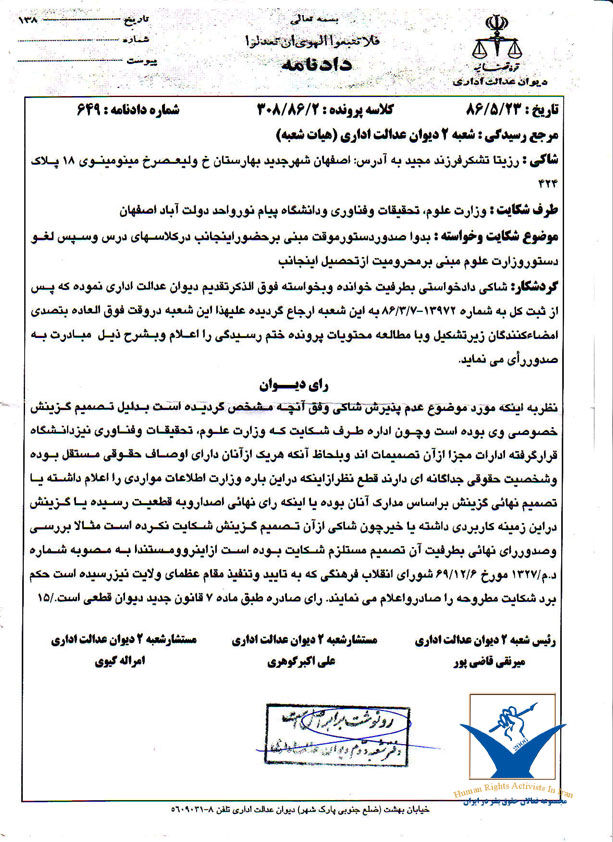
Below is a copy of a notarized letter from the Court of Administrative Justice of Iran, in response to the appeal of Rozita Tashakor, one of the above mentioned Baha'i students, rejecting her appeal based on article number D.M., dated February 25, 1980, of the Supreme Council of Cultural Revolution, sanctioned by the Supreme Leader.


[Posted on September 30, 2009, at hra-news.  Translation by Iran Press Watch.]


Ray-i-Divan

Deprived of Education

Posted: 07 Oct 2009

education Editor's Note:  The following is a letter written by a Baha'i college student upon expulsion from the university at which she had been studying.  This letter appears below in translation.

I, Mona Rezai, born in 1989, participated in the National College Entrance Exam during the academic year 2008-2009, and was admitted to Mashhad's Sajad University, majoring in electronic engineering.

After completing the administrative steps of the registration, I started my studies with my fellow non-Baha'i students in this university.  After a year, I was summoned by the Students' Affairs Department and was questioned about my religion.  Subsequently, I was informed that Baha'i students are not allowed to continue their higher education.

On September 12, 2009, when I returned to school to register electronically for my third semester, the webpage for course selection was blocked, and I was not able to continue the registration process.  Therefore, I returned to the Students' Affairs Department.  The Director of this department explained that they had received a new protocol from the National College Entrance Exams Organization, and according to this protocol I was barred from continuing my education.  However, he added that I had the right to refer the matter to the National College Entrance Exams Organization, or the Department of Faculty and Students Admission in Tehran, for further investigation.  I also received the same explanation from the Security Department.

I have submitted a letter to the Educational Council of the University in order to investigate my status.

Although this is not the first time that Baha'i students have been deprived of their right to receive a higher education, it is hoped that this issue will be resolved in the near future.

We have been promised that one day Iran will be an example of a paradise where people can live with no prejudice and all will have important roles in improving and developing this country.

Mona Rezai

[Posted on Thursday, October 1, 2009, at hra-news.  Translation by Iran Press Watch.]