Monday, June 8, 2009

A gift to a loved one extended from behind bars


A Gift from Evin

Posted: 05 Jun 2009

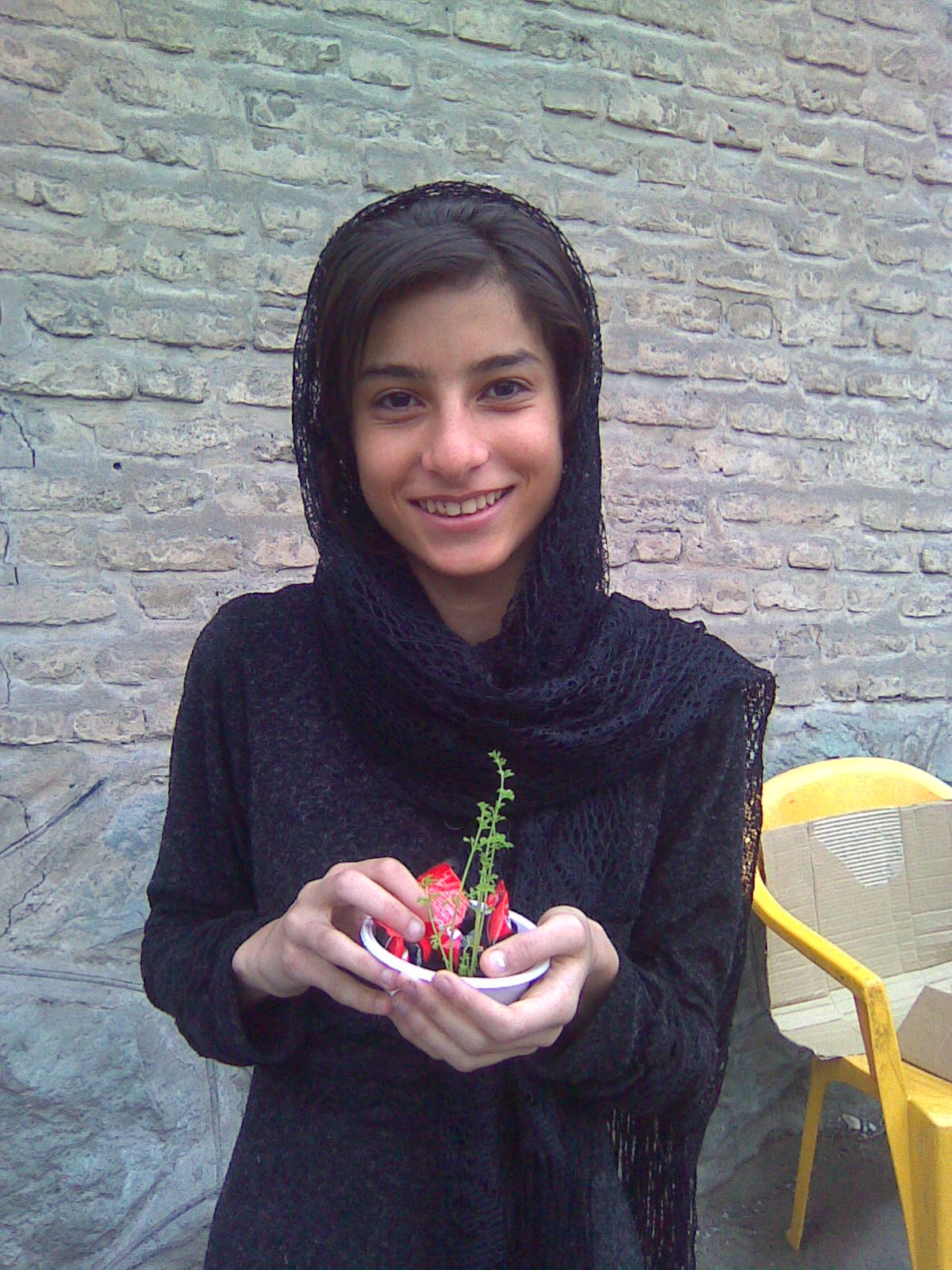
faribas_gift_to_taraneh_in_prison_121287 Mrs. Fariba Kamalabadi, six other former Baha'i leaders known as the Yaran, and some other Baha'is continue to languish in the notorious Evin prison of Tehran. While their bodies suffer incarceration and psychological torture, yet their indomitable spirits shine ever so brightly, thinking of their families, friends and millions of well-wishers around the globe.

Mrs. Kamalabadi's younger daughter, Taraneh, had a birthday come up in March. Her mother thought about her birthday, but alas there was so little she could do for Taraneh from behind bars! Nevertheless, she was resourceful enough that she grew for her a small plant, – a reminder that life and love sprout for these souls even under the harsh conditions of prison – and gave that as a gift to Taraneh.

The attached pictures show the plant and the happy young lady. Next year, we pray, the family will be able to celebrate Taraneh's birthday in their happy home, where the entire family will come together – far from dark memories of Evin.

Iran Press Watch is grateful to Mr. Iraj Kamalabadi (Fariba's brother) for these photographs.

havij-dsc00133


From iranpresswatch.org.

Last two-months: Pressure, aggression, harassment, arrests, detentions, attacks undergone by Bahá'is

 
From iranpresswatch.org.
 

Posted: 06 Jun 2009

Article 18 of the Universal Declaration of Human Rights states:

Everyone has the right to freedom of thought, conscience and religion; this right includes freedom to change his religion or belief, and freedom, either alone or in community with others and in public or private, to manifest his religion or belief in teaching, practice, worship and observance.

In recent months, violations of the rights of the Baha'is of Iran and harassment have escalated.

Even though more than one year has passed since the arrest of the seven informal leaders of the Baha'i community of Iran, the Revolutionary Court has not yet issued a verdict.  The detainees spend their days in confinement, uncertain of their eventual fate.  Summonses, arrests, detentions, harassment and pestering of members of the Baha'i community continues.

This report is a summary of the human rights violations from March 21 to May 21, 2009.  However, it should be noted that this report only covers encroachments that have been reported in the media.

Summonses of Baha'is to Offices of the Ministry of Intelligence

From the start of the Iranian New Year (March 21, 2009), numerous Baha'i citizens have been summoned to various offices of the Ministry of Intelligence across the country and have been pressured to denounce their religious beliefs.

On April 4, Sima Habibian, Nasrin Ghadiri, Nahid Ghadiri, Kaviz Noozdahi, Houman Bakht Avar, Davood Nabil Zadeh, Rozita Vaseghi, Mahsa Aghdas Zadeh, Nima Nabil Zadeh and Noora Nabil Zadeh were summoned and interrogated in the city of Mashhad. Attempts were made to pressure them to agree that they would not participate in any type of activities related to their religious beliefs and convictions.

In Hamadan, Farz Pour Hamzeh was summoned and interrogated.

On April 22, Izzat'u'llah Ahmadian, Babak Rouhi, and Soheil Hamed Nasir Zadeh were called to the office of the Ministry of Intelligence in Mashhad. Attempts were made to pressure them into signing a written contract that would forbid them from participating in Baha'i activities. Ramin Ghadiri was also called to the office of the Ministry of Intelligence in Tonekabon.

On May 3, two of the Baha'is of Hamadan, Parviz Saifi and Behrouz Rashedi, were transferred to the local office of the Ministry of Intelligence. They were required to sign a contract, agreeing that they would not accept any type of responsibility or commitment in their Baha'i community whether educational, training or service-oriented.

On May 12, seven Baha'is, Rozita Vaseghi, Nasrin Ghadiri, Sima Rajabian, Nahid Ghadiri, Kaviz Noozdahi, Houman Bakht Avar and Davood Nabil Zadeh were summoned to the Revolutionary Court of Mashhad and were charged with "propaganda against the regime", and "activities against the security of the country".

Attacks on the Homes of Baha'is

Pressure, aggression and harassment of Baha'is have not been limited to arrests and detentions. In different cities, they have also been subjected to numerous threats and their homes have been targets of mob attacks.

On March 31, in Semnan, a gang unknown to Paymon Shadmon, pounced on his car and damaged it. They sprayed paint and wrote slogans on his car. The same individuals appeared at Mr. Shadmon's work place and wrote inflammatory anti-Baha'i remarks on the walls.

A gang riding on motor bikes attacked, threw stones and broke windows in the home of Yahya Hedayati in the middle of the night, on three different occasions.

On April 23, the clothing store of Siamak Ebrahimi Nia in Tonekabon was padlocked. Previously he had spent time in jail, charged with "teaching activities for the misguided Baha'i sect"

On April 24, a gang attacked and shattered the windows of the vehicle of Yahya Hedayati. Attackers had left a note reading, "this is the ultimate fate of the Baha'is".

In Semnan, the vehicle of Nezam'u'din Fanaian, (spouse of Sahba Rezwani, who was arrested on March 6, 2008, and is spending her three year sentence in Tehran) was subjected to an attack.

Arrests and Detentions

The arrests of Baha'is in the past two months have continued as before. At present many Baha'i citizens are in jail under unknown and/or unclear charges. The first arrest of a Baha'is in the current Iranian New Year was that of the 24-year-old Sahba Khademi Deljoo on April 2, in Hamadan. In February, the Islamic Militia had gone to her residence to arrest her, but she had not been at home.

The second arrest of the year was that of Ali Ehsani, a resident of Semnan, on April 6. It should be noted that prior to this date, his store had been the target of an attack.

On April 9, Afshin Ahsanian of Shiraz was arrested after he was summoned to the Ministry of Intelligence Office. On the same day, Mohammad Reza Kondi was arrested at his home in Sari.

On April 10, three Baha'i youth by the names of Soroor Savarian, Samira Ayoobi and Paymon Aghdasi were arrested in Hamadan.

On April 14, agents of the Ministry of Intelligence arrested Moshfegh Samandari in Babol.

On April 21, Michelle Esmail Pour was arrested in Tonekabon in the province of Mazandaran.

On April 25, Vahdat Dana was arrested in Shiraz. He had been summoned twice before the date of his arrest, once by telephone and another time by agents showing up at his home without an arrest warrant. On the third time, he was arrested by authorities, who appeared at his door with a warrant.

On April 26, Shahram Safajoo was arrested at his home in Karaj.

On April 27, Siamak Ighani and Susan Tebyanian, residents of Semnan, were arrested while they were at their respective homes.

On March 30, Behnam Rouhani Fard was arrested in Yazd.

Issuance of Verdicts

In the past two months, the Revolutionary Court has issued verdicts against some Baha'i citizens.  Most of these Baha'is had been charged with "promotion of the Baha'i sect". Among those charged was Simin Gorji of Ghaem Shahr who has been sentenced to a prison term of one year at hard labor.

She had been arrested previously as well.

Twenty-four year old Pouya Tabyanian, a Baha'i resident of Semnan who was arrested on Feb 9, 2009, was sentenced to a jail term of 2.5 years. Mohammad Reza Kondi was sentenced to 7 months in prison.

Gatherings of Baha'i Students Deprived of Obtaining Higher Education

Baha'i citizens, due to their religious beliefs, are deprived of higher education. In some cases gifted students are prohibited from attending special schools that require declaration of their religious beliefs. There have been a few instances in which Baha'i students were permitted to enter universities; however, they were subsequently expelled.

Deprivation from higher education started 30 years ago when the Islamic Republic was established, and it has continued to this date. Recently a number of Baha'i students who had been denied access to higher education attended a forum on the right to education in Tehran to express their objection to this violation of one of their most basic human rights.

Article 26 of the Universal Declaration of Human Rights states:

Everyone has the right to education. Education shall be free, at least in the elementary and fundamental stages. Elementary education shall be compulsory. Technical and professional education shall be made generally available and higher education shall be equally accessible to all on the basis of merit.

 

Persecutions in Semnan encapsulate Islamic Republic's campaign against Bahá'ís

 
Excerpt:
The story travels down three main veins: organized seminars vilifying the Baha'is, resulting in assaults perpetrated against person and property - both by organs of the state and by the laity - culminating in summary arrest and incarceration on charges which are obviously false, though sadly they are enforced. Semnan's size allows us to follow individual families, to see what it is to be a Baha'i in such troubled times.
From iranpresswatch.org.

Semnan: A microcosm of Iran

Posted: 07 Jun 2009

 Without mincing words, the story of Semnan is a chilling tale of organized, religiously motivated action against Baha'is. There is a subset of the population which is different only in belief; well-wishers of the nation, productive members of society. Actions against them in the past two years have become more ominous, with spontaneous acts of the ignorant replaced and bolstered by an actively organized campaign designed to whip the populace into a frenzy: both to perpetrate crimes against and to applaud injustice towards the hapless, harmless Baha'is.

Iran is a vast country, and the long story of the persecution of the Baha'is spans its breadth for over 150 years; it is difficult to grasp so much history in its totality, so I won't presume to deal with it. However, the past few years have witnessed a surge in coordinated attacks on Baha'is throughout Iran. So let me present that story in a manageable format - call this the Cliff-notes. Semnan is a model of this intensification - the outrages in this city of 120,000 are generalizable to the nation as a whole. I wish I were making this up, or being dramatic.

The story travels down three main veins: organized seminars vilifying the Baha'is, resulting in assaults perpetrated against person and property - both by organs of the state and by the laity - culminating in summary arrest and incarceration on charges which are obviously false, though sadly they are enforced. Semnan's size allows us to follow individual families, to see what it is to be a Baha'i in such troubled times.

Assaults

During December 2008, in the early hours of the morning, the houses of twenty Baha'is are descended upon by officers of the Ministry of Intelligence. Unmarked cars disgorge up to twelve officers, who first seize mobile phones, cut landlines, stop children from attending school - sometimes refusing to show any official documents. The houses are then upturned; paperwork, documents, personal belongings, laptops, computers, peripherals, satellite dishes, Baha'i Holy texts and all are confiscated. Especially unfortunate was Mr. Behrooz Khanjani, who had a quantity of cash, deeds to properties, licenses for conducting a business and work permits stolen from his safe-box, an insult which was followed in March 2009 by the forced shuttering of his store, without any charge - sadly this was just the beginning for Mr. Khanjani's family.

These raids were centrally organized, as indicated by the status of the offices and the provenance of their vehicles (Tehran, which is ~220km distant), and had not the least bit to do with intelligence gathering - they stole valuables, not "evidence"; some officers hadn't any idea what they were looking for; they were more looting than spooking. Some were even ashamed of their acts: "I have been ordered to do so. Please believe me." Or "Please pardon what I'm doing." And most saying "For God's sake, do not suppose that Islam is perpetrating these acts!" Why send in the troops if they don't know what to do? To terrify and demoralize, and to further impoverish a community that has been economically strangled (http://www.iranpresswatch.org/2009/03/economic-strangulation/ ).

April 2009: The cars of two Baha'is were vandalized, including the Fanaian family car. Rocks broke their windows, and a chemical agent was applied that damaged the exterior of the automobiles, coupled with a pleasant note "This is how the Baha'is will end up."

February 2009: Home-made incendiary devices (Molotov cocktails) were thrown at the windows of three Baha'i residences, including the Khanjani household - all three had been victims of the December raids. They thankfully failed to break the windows or cause any injury. These occurred less than a week after a seminar held by the chief cleric of the city (Imam Jum'ih), who expressed a desire to "rid this nation of the Baha'is".

February 2009, Semnan Baha'i cemetery. Even the deceased don't escape, as fifty headstones and trees grown in honor of the dead were irreparably damaged, and the room used for funerals was trashed and torched. Graffiti both inaccurate and misspelled (implicating youth or laypersons as suspects) besmirch the gas and water tanks:

  • The cemetery of the infidels living in Semnan.
  • [We] spit on the souls of Baha'is and on their dead.
  • We will kill each and every one of you. Baha'is are big fools!
  • Baha, Bab, the Ruhi program (the Faith's twin Founders, and a deepening program based on the Baha'i texts respectively); All of you [Baha'is] are impure. Get the hell of out here!
  • Your browser may not support display of this image.Bastard Baha'i!
  • Your browser may not support display of this image.Get the hell out of Iran! Death to Israel and England!
  • Death to the infidel Baha'is!
  • Filthy, infidel Baha'i!
  • Death to Israel!

Why are they afraid of the dead? (http://www.iranpresswatch.org/2009/01/why-are-they-afraid-of-the-dead/ )

March 2009, A family who were raided in December were further insulted: their store was attacked and half of the merchandise that provided their livelihood was stolen.

April 2009, A victim of the car vandalization discovered the threats were not empty - he had the windows of his house broken on three separate occasions within the month. The assailants were on motorbikes; to date the authorities have not taken any action.

Arrests

December 2008: Mrs. Fanaian, at the time a member of the local Baha'i administration, was arrested and held without charge, after having her home invaded and her car vandalized in the previous months. Finally she was sentenced to 3years and 8 months imprisonment, and transferred to the infamous Evin prison in Tehran. Her sentence has more recently been reduced by 8 months, for which she is grateful.

January 2009: Three former members of the local Baha'i administration were summarily arrested after security agents descended on their homes. These same three had been jailed unjustly three years ago, and released on a suspended sentence, a precedent that was cited in their current conviction, which carried a six month sentence. To date the judiciary has not stated the reasons for the arrests or the charges upheld against the three.

March 2009: A twenty-four-year-old male was arrested at his workplace by the Ministry of Intelligence. He is guilty of being a Baha'i (though not in the - now disbanded - administration [http://www.iranpresswatch.org/2009/03/in-memory/ ] ). He was sentenced to two and a half years of incarceration for "propaganda against the regime", "activities against national security" and "teaching the Baha'i religion".

April 2009: A twenty-nine-year-old, a victim of earlier raids, was summoned to the office of the Ministry of Intelligence purportedly to answer some questions. After being interrogated, a bail of 40,000,000 Tuman (approx. $41,000; for reference, yearly GDP per capita in Iran is $12,800) was demanded, but as it was the end of the day the bail was not processed. The next day his family took the amount in full to the court, but were refused without explanation. More heart-rending is that he has a wife and two children (aged five and seven years), and that on the same day his medical and dental supply store was broken into by the authorities without a warrant, and everything - including the office furniture - was transferred to the Bureau of Intelligence. Stripped of husband, father and livelihood in a single day!

His crimes? Verbally communicated, they were: propaganda against the regime, and - stunningly - lack of labels on store items - honest!

April 2009: Two Baha'i business partners, both victims of the raids, were arrested at their store. One - a relative of the twenty-four-year-old - has intermittently been allowed to have her eighteen month old daughter to stay with her in prison. She also has a seven-year-old son who was denied his wish to accompany his mother into prison. No other details are available about these imprisoned Baha'is or the charges against them.

Seminars

These public gatherings are characterized by three things: slander against the Baha'is, exhortations for the common people to rise up against them, and the fact that they are shortly followed by attacks on the local Baha'is.

November 2008, Halal Ahmar lecture room. Muhammad Anjavinejad gives a seminar on the "Sinister Shadow" regarding the relationship of the wayward sect (the Baha'i Faith) and Zionism. (a baseless claim, explained here: http://www.iranpresswatch.org/post/1983 ). The audience targeted for this exposition of the false were teachers, religious instructors and youth.

February 2009, Friday sermon: Ayatollah Siyyid Muhammad Shah-Cheraqi the Imam Jum'ih of Semnan (the supreme religious authority) referred to the letter of the Attorney General to the Minister of Intelligence (http://www.iranpresswatch.org/2009/03/najafabadi-moi/ ) which appealed for severe and final confrontation with the Baha'is through legal channels (curiously this document admits that Bahai's undertake socio-economic, humanitarian and educational development programs, but are still, somehow, inveterate enemies of Iran) and elaborated that "In the same way that the people were able to throw the Shah out of Iran, they can rid this nation of the Baha'is." As if a veiled reference to purging or mass exile of some 300,000 innocents was not enough, he salted the wound: business with or marriage to a Baha'i is condemned.

March 2009, 'Abedinih Mosque: Nasiri-Fard gave a public seminar titled "Ways to Combat the Wayward Sects of Baha'ism and Wahhabism." (http://en.wikipedia.org/wiki/Wahhabi ) Large advertisements were posted across the city inviting the populace to this public seminar.

Some may call me disingenuous, because I, a Baha'i, am campaigning to have the stories of Baha'is heard. Some may argue that the world is lousy with suffering, why should anyone be concerned about a handful of people in a relative backwater? Yes, I am a Baha'i! and because I know that a Baha'i is a well wisher of the world, how could I not give voice to my heartbreak, that they're suffering by the hand of the country that they succor, that they love! And lousy indeed would be a world that ignores suffering because there was too much of it, in which we wring our hands but keep on, as if doing something to aid the helpless is somehow beneath our station as human beings. The world is full of grey areas - this is not one of them! There is systematic, orchestrated injustice and attempts to agitate the fervor of the populace, all for the persecution of a minority that is the stark opposite to their official vile depiction. Historically, similar situations have resulted in world-horrifying outcomes: I pray that it doesn't happen here.


Friday, June 5, 2009

Fourth nationwide meeting on Right to Education in Iran

 
Yet an inspiring report from a meeting of this committee under the aegis of the Human Rights Activists in Iran Association.
From iranpresswatch.org.

Forum on the Right to Education held in Kermanshah

Posted: 01 Jun 2009

meeting On Saturday May 30, 2009 a forum on the right to education convened as a fourth meeting of its kind nationwide. The Committee on the Right to Education, which is a branch of the Human Rights Activists in Iran Association, sponsored this forum in which many human rights activists and students deprived of the right to education were in attendance.

Mr. Abolfazl Abedini, the Association's public relations officer, opened the meeting by recounting the activities and goals of his organization especially on the subject f the right to education. He also expressed gratification that this form was held in Kermanshah, a region that has contributed many dedicated activists to society.

After the opening remarks, Mr. Hesam Missaghi spoke on behalf of the Committee on the Right to Education. He expressed that the man goals of his committee are reversing the trend of denial of the right to education and returning the disenfranchised students to schools and universities. Mr. Missaghi, who himself has been denied his right to education, continued that the committee has focused on the two approaches of the law and its practice. The former consists of the international covenants and human rights. The committee's goal in this regard is to educate the Iranian public by raising awareness, providing legal support, developing capacity, and providing education. Mr. Missaghi concluded his remarks by reiterating the goals of unity and cohesiveness of its members and followers within the framework of the rule of law.

kermanshah1 Next, Mr. Peyman Ghiami, the coordinator for the Committee on the Right to Education in Kermanshah, presented his speech. He expressed gratitude that the forum was held in Kermanshah and stated that he was hopeful that such forums will provide a bridge to connect his province's civil activists with the Human Rights Activists in Iran Association.

Next speaker was Mr. Kaveh Ghasemi Kermanshahi, a student activist and a senior member of Kurdistan's Human Rights Organization, who recited a statement on behalf of his organization. His statement condemned the denial of education to the Bahá'í community and others. The full text of his statement has been made available on the Association's website.

After this statement, Ms. Mona Rafii, a student expelled from Razi University, presented her speech. She stated that three months after enrolling as a student, she received word that she may no longer continue her education. The multiple attempts to restore her status as a student have been fruitless. The authorities have stated that her belief in the Bahá'í faith is the reason for her dismissal.

lady Following Ms. Rafii, Mr. Farzad Pourmoradi, a journalist and a human rights activist from Kermanshah, addressed the audience. He expressed his profound regret that such denial of education, which is in stark contrast to the fundamental principles human rights, is ongoing. This civil activist, who himself has had a significant history of confrontation with the authorities as a student, concluded his speech by expressing appreciation that such forums are being held and noting that he is prepared to support the Committee on the Right to Education.

The last speaker was Dr. Eslami, who was one of the first victims of denial of the right to education. He recounted his dismissal from the doctorate program from Tehran University in the first few years of the Islamic Republic. He also shared a brief history of the denial of education to the Bahá'í community from the beginning of the Islamic Revolution to the present time.

See more photographs at: http://hra-iran.net/index.php?option=com_content&view=article&id=1175:right-to-seek-higher-education-committee-holds-fourth-meeting&catid=66:304&Itemid=293

[Source: HRA Iran at http://hra-iran.net/index.php?option=com_content&view=article&id=1175:right-to-seek-higher-education-committee-holds-fourth-meeting&catid=66:304&Itemid=293]


Where teaching children is a crime - honoring three imprisoned teachers in Shiraz

 
From iranpresswatch.org.

Coloured Pencils

Posted: 01 Jun 2009

shiraz1

Editor's Note:  The following is a translation of a short essay that recently appeared in Persian on the occasion of the third anniversary of the arrest of 54 Baha'i youth in Shiraz.  The original Persian text is attached as well.

Short and long colored pencils, dusty crafts, a large quantity of wall posters on various educational subjects — are all thrown in many boxes and are collecting dust.

These are things used for some time by 54 Baha'i youth of Shiraz and several of their Muslim friends to teach children in several underprivileged districts around Shiraz.

Their work proceeded until May 19, 2006, when a group of armed men confiscated their colored pencils, posters, paintings, and crafts, and then arrested all the teachers and took them away.

Interrogation of the Baha'i youth went on for many days.  From that day on, there were no classes for the children in the underprivileged areas, so that they could learn the importance of respecting parents, personal hygiene, proper discipline and organization in conducting personal affairs, showing compassion, regard and respect for others, affability towards one another, friendly ways to play, cooperation and collaboration, daily prayer to Almighty God for aid and assistance, and such things.

There were no more classes in which the children could be happy being together and experience the joy of learning and helping one another.  Perhaps these children learned those things during the short period when they had these classes - and perhaps not.  But the thing which certainly remains forever inscribed in their hearts is the sacrifice of those who shouldered great hardships and undertook immense tois, who were not afraid of dangerous consequences in order to come forth and hold these classes and lovingly help those whom they did not know.

Perhaps you might ask:  Why do we recall these events of 3 years ago?

In response, I would remind you that three of these Baha'i youth - these Baha'i teachers of children's classes - have been incarcerated for the last 19 months in the most inhospitable prisons and under harsh circumstances.

I wish that colored pencils and crafts had tongues to testify that indeed these Baha'i youth have been imprisoned unjustly, and that they have not committed any crime - nay, indeed, they arose through their human feelings to help children who needed help.

But no!  If these colored pencils and crafts also had tongues they too would be arrested on the charge of being instruments of espionage and means for disrupting national security, and would be thrown in prison or burned.


Human rights an issue in Iran elections


A political thaw in Iran is evident in the fact the former taboo of discussing human rights is confronted.
(Excerpt:)

For Mrs. Diane Alai, spokesperson of the Baha'i International Community, the statements made by Mrs. Kadivar are to be assessed very positively, because through them it becomes apparent that the violation of human rights is in fact being discussed in Iranian society. It must be added that the human rights of Baha'is are nevertheless violated systematically by the totalitarian Islamist state.

Diane Alai emphasized that just as the Baha'is stand up for human and women's rights or the freedom of study for all Iranians, there is also solidarity within Iranian society with the Baha'is. Diane Alai accentuated that today many Iranians disapprove of the state oppression of Baha'is.

From iranpresswatch.org.

Persecution of Baha'is and the Iranian Presidential Elections

Posted: 04 Jun 2009

Editor's Note: The editors are pleased to present this article; however it does not necessarily reflect the opinions of IPW, which is supportive of the government of the Islamic Republic of Iran in the legitimate exercise of its duties.

by Wahied Wahdat-Hagh, columnist for Welt Debatte (World Debate)

In the run-up to to the so-called presidential elections in Iran, the persecution of Baha'is has become a political issue. Jamila Kadivar speaks of the rights that members of the religious community of Baha'i have as Iranians. In the meanwhile, during an election rally in Isfahan young Baha'is demanded their right to be admitted to college and university.

In Iran, only four Islamists from the group of the founders compete for the position of the Iranian President: current officeholder Mahmoud Ahmadinejad; Mohsen Rezai, ex-general of the Iranian Revolutionary Guards and "moderate conservative"; Mehdi Karroubi, co-founder of the Association of Combatant Clerics Party; and Mir-Hossein Mousavi, ex-Prime Minister.

There can be no question of free elections. Rather, the so-called presidential elections point to the fact that the Islamist establishment of the totalitarian dictatorship of Iran does not always agree regarding tactics about how to achieve the goals of the Islamic revolution.

It is interesting that the persecution of Baha'is has become an issue prior to precisely these pseudo-elections in Iran.

Jamile Kadivar defends the rights of Baha'is as Iranians

The freedom of Baha'is has become an issue with reformist Islamist intellectuals. For example, Mrs. Jamila Kadivar, a professor of political science who is campaigning on behalf of the election of the cleric Mehdi Karroubi for President, has expressed: "Baha'is have rights as Iranian citizens which the government has to recognise and officially acknowledge."

Ayatollah Montazeri has expressed himself in a similar vein. Yet he has furthermore argued that it is necessary to nevertheless fight the Baha'is politically, because as a Muslim he does not accept the Baha'i religion.

For Mrs. Diane Alai, spokesperson of the Baha'i International Community, the statements made by Mrs. Kadivar are to be assessed very positively, because through them it becomes apparent that the violation of human rights is in fact being discussed in Iranian society. It must be added that the human rights of Baha'is are nevertheless violated systematically by the totalitarian Islamist state.

Diane Alai emphasized that just as the Baha'is stand up for human and women's rights or the freedom of study for all Iranians, there is also solidarity within Iranian society with the Baha'is. Diane Alai accentuated that today many Iranians disapprove of the state oppression of Baha'is. Iranian Baha'is merely want to practise their religion, like all other Iranians, and to be of service in promoting the progress of their country as Iranians, Alai said in an interview with Radio Zamane.

Ayatollah Khomeini: Baha'is have no rights in Iran

Hossein Shariatmadari, editor of the newspaper Kayhan and an advisor to the Iranian "leader", however, portrays Jamila Kadivar as a traitor. Kayhan, a newspaper which is regarded as the mouthpiece of the second Supreme Leader Ayatollah Ali Khamenei, repudiates the Baha'i-religion. In Iranian legislation, the Baha'i religion also is not acknowledged as a religion. Shariatmadari is of the opinion that Baha'is are a "political party, the fifth column of Israel and a terrorist group".

Shariatmadari also quotes the first Iranian Supreme Leader Ayatollah Khomeini, who already demanded in the year 1962 that "Baha'is should have no right to conduct religious meetings". Today this has become state law.

Supporters of Ayatollah Borujerdi defend Baha'is

Adherents of the arrested Ayatollah Kazemeini Boroujerdi in a statement have criticized state oppression against members of the Baha'i religion.

The state of health of Ayatollah Boroujerdi, who is imprisoned, is at present particularly critical. This Shiite cleric calls for the separation of religion and state, which indeed would undermine the ideological basis of the prevalent Khomeinist state ideology of the "absolute reign of the clergy" (wilayat-e faqih).

State persecution of Baha'is is against the law

The dissident Iranian journalist Hossein Kashani believes that, when dealing with Baha'is, not even the prevailing criminal legislation is being considered. For example, it is stated in paragraph 570 of the Iranian criminal legislation that all "state authorities that - other than stipulated by law - violate the personal rights of individuals" must be punished.

In Iran, however, they are being rewarded.

To Kashani, even according to the prevailing Iranian law the treatment of Baha'is is illegal.

Kashani points out that Mahvash Sabet, one of the seven men and women who are imprisoned as members of a national ad hoc committee of the Baha'i community, had already been arrested on March 5, 2008. She had - as with many other Baha'is - been asked unofficially to report to the secret service, and had then been arrested. The reason for her arrest was that she had taken care of the funeral of a Baha'i in Mashad. Arbitrarily, Baha'is are prevented again and again from burying their dead. Recently, the compound of a Baha'i cemetery in the northern province of Mazandaran was even offered for sale by Iranian authorities. The cemetery had been destroyed beforehand, according to a Human Rights Activists Iran report.

Also for the other six leading Baha'is who have been imprisoned since 14th May, there are only absurd accusations - no concrete ones. They are accused of being spies, plotting conspiracies and campaigning against the State. Meanwhile they have been charged with "mofsed fel-arz", "being spreaders of corruption on earth". Islamic law stipulates the death penalty for this "crime". Kashani writes that magistrates often deliver their judgments out of pure "religious fanaticism".

The seven Baha'is have hardly seen daylight for one year. They live in small cells that have no window. During the week, they only have a possibility to receive a little daylight for a few minutes when they leave the room. According to Kashani, they must sleep for over one year on a hard concrete floor, so that their bodies already show painful wounds.

Kashani also mentions the fact that during regular arbitrary arrests Iranian state officials literally steal the private property of the Baha'is, ranging from cash to valuable objects to sacred books.

It has often happened that during arrests even children have been tortured.

Baha'i-students protest

As Iran Press Watch reported on 29th May, young Baha'is meanwhile protested in favor of the right of Baha'is to be admitted to college and university. During a speech of the presidential candidate Mir Hossein Mousavi at Isfahan University on Saturday 22nd May, young Baha'is silently held up banners, on which the right of Baha'is to pursue academic studies was demanded.

Plainclothes members of the secret service immediately confiscated the posters. Candidate Mousavi, however, did not even react to this incident.

[Source: Welt Debatte athttp://debatte.welt.de/kolumnen/73/iran+aktuell/132674/die+verfolgung+der+bahai+und+die+iranischen+praesidentschaftswahlen?req=RSS&print=1; Translation by Polly Janitzky]


Monday, June 1, 2009

Property rights of Bahá'ís neglected - Cemetery confiscated

100 Year Old Baha'i Cemetery is being Auctioned Off near Sari

Posted: 31 May 2009

dsc007411 The Baha'i Cemetery of near the Village of Ayval on the Kiasar-Sari road has been placed for auction, in order to be converted to residential property.

This cemetery is more than 100 years old, and this auction has been announced in 2 national papers, Hamshahry and Iran.

In 1983 under severe pressure and persecution 20 Baha'i families living in Ayval were forced to leave, leaving all their property,personal belonging, and houses behind. This is a small farming community. Despite their attempt to seek a court order to return they have been denied and their homes have mostly been destroyed or burnt.

Now their 100 year old cemetery is being put up for auction.

[Source: http://hra-iran.org/index.php?option=com_content&view=article&id=1152:a-100-year-old-bahai-cemetery-is-being-auctioned-off-near-sari&catid=66:304&Itemid=293]

From iranpresswatch.org.