Wednesday, April 21, 2010

Young Baha'is - harshly imprisoned - allowed meeting with families

 
From Iran Press Watch.

Posted: 18 Apr 2010

Navid Khanjani
Navid Khanjani

RAHANA - On Thursday April 15, the families of Navid Khanjani and Dorsa Sobhani were allowed to visit their children in prison. According to the Edu-right.us, the families of education-deprived students Dorsa Sobhani and Navid Khanjani were able to receive permits for in-person visits after following up their request at the prosecutor's office and visiting the prosecutor. Navid Khanjani was described to be in [good?] physical and emotional condition during this visit; however, Dorsa Sobhani was not in good physical condition. Navid Khanjani is a co-founder of Population of Combat against Education Discrimination and a key member of Committee of Human Rights Reporters (CHRR). He was arrested on March 2, 2010 in Isfahan, then transferred to the IRGC-controlled ward inside Evin prison in Tehran. He has been reportedly under lengthy and intense interrogations to accept heavy charges.
A few days after his arrest, pro-government media released news titled "Members of Organized Cyber War Networks Arrested", in which they had mentioned Navid Khanjani's name along with other members of the CHRR as key convicts of that case. This incidents has raised concerns about "creating a security case" against him and other arrested Baha'i students who have been banned from education.
Dorsa Sobhani was arrested on March 7, 2010 at her house in the city of Sari in Mazandaran province. In an earlier, short phone call, Sobhani had notified her family that her "interrogations were over"; however, after 40 days there is still no information available regarding the reason of her arrest, and neither her nor Navid Khanaji's lawyer has had any access to their clients' files.


Source: RAHANA, 15 April 2010   http://www.rhairan.info/en/?p=2606,

Thursday, March 4, 2010

Another prominent human rights reporter arrested in Iran

 
Among the number of stories appearing each day about the persecution of Bahá'ís and rights activists alike in Iran, here is yet another vivid example of the lengths to which the Islamic Republic will go to silence every significant voice of protest against the atrocities being perpetrating against its people.

From Iran Press Watch.


CHRR Member Navid Khanjani Arrested

Posted: 03 Mar 2010

Committee of Human Rights Reporters (CHRR) – Student and civil activist Navid Khanjani was arrested at his home in Isfahan on March 2, 2010.

arton8701
Navid Khanjani
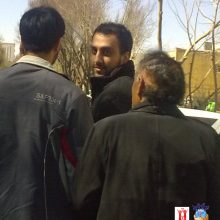
Navid Khanjani Navid Khanjani close to Nikbakht Court as he bids farewell to his family and being taken to Evin Prison (Wed 3 Mar. 2010)
According to reports, around 11:30 pm, six security forces searched his home and confiscated his personal belongings, including his computer. Security forces had brought Navid’s sentence from the Revolutionary Court along with them.

The forces informed Navid that he will be taken to Nikbakht court in Isfahan and transferred to Evin prison tomorrow.

Navid Khanjani is a member of the Committee of Human Rights Reporters and founder of Population of Combat against Educational Discrimination. He is regarded as a significant figure in educational rights awareness.

Additionally, due to his belief in the Baha’i faith, Navid Khanjani was banned from continuing his education.

Currently there are a total of seven CHRR members who are detained. The names of detained CHRR members are: Shiva Nazar Ahari, Koohyar Goodarzi, Navid Khanjani, Saeed Jalalifar, Saeed Kalanaki, Saeed Haeri, and Mehrdad Rahimi

Source: CHRR: English, Persian;

Pictures from: http://www.schrr.net/print.php?articleid=8701

Source: http://www.iranpresswatch.org/post/5772
 

Wednesday, March 3, 2010

Life as a Baha’i in Semnan: the case of Mr Hedayati


Semnan, Iran: The small city is a fertile breeding ground for anti-Baha'i activities

Posted: 01 Mar 2010

Semnan, Iran

Semnan, Iran

[Editor: Semnan seems to be a testing ground of systematic anti-Baha'i activities in form of persecution, arrests, refusal to education, and refusal of all community life including burial. Iran Press Watch has carried many stories covering these actions against the Baha'is in Semnan.]


RAHANA – Semnan, known for its carpets and textile industry, is a small city at the southern foot of the Alborz Mountains in Northern Iran. The small city is also a fertile breeding ground for anti-Baha'i activities, and the anonymity prevalent in larger cities is non-existent. Members of the city's Baha'i community are regularly harassed, their houses and businesses set on fire, and their cemetery desecrated by unidentified gangs – gangs that walk away unpunished and unprosecuted by the authorities. For their part, city and government authorities have not stopped bullying the Baha'i community, with tactics ranging from flat-out arrests and day long interrogations to refusal to issue burial permits for the deceased members of the community.
No one knows the scope of the difficulties of life as a Baha'i in Semnan better than Yahya Hedayati, who has spent over 4 years of the past decade in prison in Semnan and Tehran. His family members have not been immune to the persecution, either; the authorities after him held his father, and Hedayati's wedding had to be delayed until after his release. These are a just a few chapters of his life.
As recently as two weeks ago, his house, along with the store of another Baha'i resident, Akbar Pour Hosseini, was set on fire in the middle of the night by arsonists. The fires caused damage to the properties, and the two men plan to pursue the matter with the authorities.
Between April 9 and May 24, 2009, Mr. Hedayati's house was attacked in the middle of the night on 8 separate occasions by unknown assailants riding on motorcycles. The incidents terrorized Mr. Hedayati's family members and often involved rocks being thrown at his windows. His car's windshield was shattered on April 22, and the note left by the culprits cited his Baha'i faith as the reason for the attack. Mr. Hedayati has written to many officials, including the Prosecutor General, Dori Najaf Abadi, to complain about his treatment.
As for Mr. Pour-Hosseini, he has had his fair share of unpleasant past incidents. Prior to the recent arson and during the Ashura and Tasoa ceremonies – two of the most important mourning days for Shiites – his store windows were broken and his store sign was vandalized. Last summer, arsonists set fire to his shop and watched as the fire immolated and nearly destroyed Mr. Pour-Hosseini's workplace.
In other news, city officials refuse to issue a burial permit for Ms. Nabili, a Baha'i resident who died two weeks ago.
 
Wikipedia article on the city of Semnan: http://en.wikipedia.org/wiki/Semnan_(city)
 

Tuesday, February 23, 2010

New tv series on Iran state network grossly misrepresents history, tenets of Bahá’í Faith

 
GENEVA – BWNS (Persian)

Bahá’ís deplore portrayal of their Faith in new tv series on government-owned Iranian national network

12 February 2010

Bahá’ís deeply deplore the malicious portrayals of Bahá’u’lláh and the Báb, the Twin Prophet Founders of the Bahá’í Faith, in a new national Iranian television network series. The characterizations degrade, ridicule, and insult these Central Figures of the Bahá’í Faith, Who are revered by Bahá’ís worldwide. The broadcast of this series is all the more lamentable in the face of the government’s loud denunciation of religious defamation in international forums.

The series, titled “Salhaye Mashrooteh” (“The Years of the Constitutional Revolution”), began on 1 February to coincide with the beginning of the ten-day celebration in Iran of the anniversary of the Islamic revolution, is being aired daily and will conclude on 15 February.

It purports to present a factual historical account of Iran’s “Constitutional Revolution” in the late 19th-early 20th centuries, a period which coincides with the establishment of the Bahá’í Faith in that country. The programs purvey timeworn and wholly unfounded allegations that the Bahá’í Faith was created by British imperialists as an anti-Islamic movement.

This current national network television series is only the most recent occurrence in an unremitting and systematic campaign of propaganda against the Bahá’í Faith by the government of the Islamic Republic of Iran. The campaign has utilized all forms of state-controlled mass media to incite hatred and, suspicion against the Bahá’ís throughout the country by flagrantly misrepresenting, denigrating, and distorting the history and teachings of the Bahá’í Faith.

Iranians eager to learn the truth have no easy access to accurate information about the Bahá’í Faith, as Bahá’ís in Iran are utterly denied the opportunity to correct the slander that is being promulgated by the authorities. Moreover, the mass media is so strictly controlled that even the mere publication of a photograph of the Bahá’í Temple in India in conjunction with an article promoting tourism to that country resulted in the immediate, albeit temporary, closure of the newspaper concerned.

Bahá’ís call upon their well-wishers to join them in seeking to counteract the falsehoods being spread by the government through wide circulation of accurate information about the Faith’s teachings. For those eager to assist in this process, the book titled “Tolouie Digar” and posted at: http://www.aeenebahai.org/node/835 and in audio version at http://www.aeenebahai.org/node/616, is offered as a reliable resource.

Source is at http://news.persian-bahai99.info/story/196. English version distributed by the National Spiritual Assembly of the Baha'is of the United Kingdom in e-mail letter dated 17 February 2010.
 

Monday, February 22, 2010

FRANCE: Company of Academics, Professionals Appeal to Iran Supreme Leader on Behalf of Bahá'ís

 
From Iran Press Watch.

LeMonde.fr

Appeal to Ayatollah Sayed Ali Khamenei, Supreme Leader of the Islamic Republic of Iran

February 21st, 2010
Appeal to Ayatollah Sayed Ali Khamenei, Supreme Leader of the Islamic Republic of Iran

Le Monde, February 5, 2010

Seven Baha’is are at risk of the death penalty in Iran today. In detention for 20 months, these five men and two women, ranging in age from 36 to 72 years, have been accused by the Iranian judiciary system of committing “corruption on earth” and of being “spies for Israel”. The group of seven, who are known in their community as the “Yaran” or “Friends”, were acting as mediators toward different agencies of the Iranian state at the time of their arrest, trying to mitigate the oppression weighing heavily on the Baha’is of Iran, who have been the subjects of constant harassment by the Islamic Republic for 30 years.
Baha’is, who constitute the largest religious minority in Iran, are considered to be non-citizens and “unprotected infidels”. Easy targets, this peaceful community numbering 300,000 is being accused of causing all the problems which are the result of political and social tensions within the country.
Today, official newspapers are accusing them of being the organisers of the troubles which are convulsing the country, an accusation which is as unlikely as all those that have proliferated for more than a century.
As the trial of the seven “Yaran” approaches, arrests, the desecration of cemeteries, pillaging, and fires destroying the property of Baha’is have multiplied. Complaints registered by Baha’is are ignored. As of today, 48 Baha’is are in prison, and 75 more, awaiting their trials, have been released after having paid exorbitant amounts for bail, or having surrendered titles to property or commercial licenses.
For thirty years, access to university has been denied to them, nor do they have the right to benefit from a pension. They cannot be hired in the public sector, and their employers in the private sector have to request a driver’s license on their behalf. Those who attack them are never questioned legally. The harassment extends to insulting school children participating in flag-raising activities.
You, Your Excellence, have yourself in the past deemed that they must be reduced to “a state of subsistence”.
Baha’is for fifty years have been putting into practice, in Iran and elsewhere, the principles of the equality of men and women and the right to education, and have been expounding, among other tenets, harmony between science and religion. By virtue of this, they are winning growing support among the Iranian population.
We ask that the systematic maltreatment, orchestrated by the reactionary wing of the clergy and the government, cease, that liberty of conscience be recognized in Iran and that these men and women be freed.
Signed:
Rosine Haguenauer, researcher, biology
Aitana Perea-Gomez, researcher, biology
Fethi Benslama, university student psychoanalysis
Malvyne Derkinderen, researcher, biology
Jacqueline Léon, researcher, linguistics
Anne Plessis, university student, biology
Genevieve Bordet, university student, linguistics
Sophie Louvet-Vallée, university student, linguistics
Cecile Sakai, university student, Eastern language and civilization
Anne Cecconello, ecology, urban studies
Jean-Pierre Hourdin, business executive
Michel Volovitch, university student, biology
Sophie Vriz, university student, biology
Jean-René Duhamel, researcher, neurosciences
Anna Montagnini, researcher, neurosciences
Eric Castet, researcher, neurosciences
Juliette Sablier, doctoral candidate, neurosciences
Daniel Diatkine, university student, history and economy
Anouchka Ibacka, linguistics student
Sophia Jomni, teacher, medical-social science
Hélène Kontzler, university student, economy
André Lapidus, , university student, economy
Claire Pignol, , university student, economy
Florencia Sember, doctoral candidate, economy
Catherine Tourre Malen, university student, anthropology
Bruno Hoen doctor at university hospital, infectious diseases
Michel Botbol, psychiatrist
Paul Kessler, researcher, physics
François Gros, honorary professor at Collège de France, biology
Lydie Koch, researcher, physics
Henri Korn researcher, biology
Dominique Schiff, researcher, physics
Gérard Toulouse, researcher, physics
Joyce Blau, university student, Eastern studies
Sonia Dayan-Herzbrun, university student, sociology
Joseph Parisi, researcher, physics
Translation by Iran Press Watch
Source: Le Monde, http://www.lemonde.fr/opinions/article/2010/02/05/appel-a-l-ayatollah-sayed-ali-khamenei-guide-supreme-de-la-republique-islamique-d-iran_1301458_3232.html#ens_id=1190750

Source is here.
 

Thursday, February 18, 2010

Government shuts down Baha’i-owned businesses, arrests owners

 
Karaj Baha’i Man Arrested & His Store Sealed

18 February, 2010

RAHANA – on January 2nd, 2010, agents from the Intelligence Ministry attempted to arrest Payam Vali at his home, but had to leave since was not home at the time of their visit. Vali was subsequently summoned to the Intelligence Ministry, and arrested upon appearance on January 3rd, 2010.
8 days before he was arrested, the municipal police had sealed Vali’s eyewear shop along with 4 other Baha’i owned businesses in Karaj.

Shutting down businesses owned by Baha’is has become common in many Iranian cities. Many Baha’is have seen their businesses shut down by municipal authorities in Semnan, Tonkabon, Yasuj, Tehran, Sari and other cities. In most cases municipal authorities tell the owner –that is if he was lucky enough not to be arrested before his shop’s closure- that there is nothing they can do about the closure because it has been ordered by the Intelligence Ministry.

Source: RAHANA
 

Wednesday, February 17, 2010

UN Human Rights Council members condemn Iran's repression of Bahá'ís, others


From Bahá'í World News Service.


Nations rally to defend human rights in Iran

16 February 2010


GENEVA — Countries from around the world have voiced strong concern at the United Nations Human Rights Council over Iran's deteriorating human rights record.

In speeches yesterday and in documents filed with the Council, nations and human rights groups described the degree to which Iran has failed to live up to its obligations under international human rights law.

"The good news is that governments and organizations are rallying to defend innocent Iranians, who have over the last year seen their human rights so gravely violated," said Diane Ala'i, the representative of the Baha'i International Community to the United Nations in Geneva.

"The bad news is that Iran continues to ignore such appeals," she said, speaking after yesterday's session of Council, which specifically focused on Iran's human rights record.

Muhammad Javad Larijani, secretary general of the Islamic Republic of Iran's High Council for Human Rights, told the session that there is religious freedom in Iran and that no Baha'i is persecuted for his beliefs. If any Baha'is are imprisoned, he said, it is because of "illegal activities" as a cult.

"Put bluntly, Iran once again completely discredited itself before the eyes of the international community," said Ms. Ala'i, noting that last week Iran arrested at least 14 more Baha'is.

Among those arrested, she said, was Niki Khanjani, the son of one of the seven Baha'i leaders who are currently on trial on false charges.

"As the Nobel laureate Mrs. Shirin Ebadi has recently stated in an open letter to the UN High Commissioner for Human Rights, Iran is now trying to increase pressure on prisoners by taking their relatives hostage," said Ms. Ala'i. "Jamaloddin Khanjani is 76. He has been incarcerated for almost two years – and then they arrested his granddaughter at the beginning of January and now, his son."

"These are the desperate acts of a regime that is frantically lashing out to blame others for its troubles and to suppress any viewpoint that is different from its own ideology," she said.

The majority of countries who spoke out against Iran focused on the violence following last June's presidential election and also on the situation of the country's religious minorities.

Brazil called for Iran to extend rights to all religious groups in the country, saying Baha'is should enjoy the same rights as everyone. Mexico said all minorities – particularly the Baha'i community – must be able to practice their religion.

"Romania and Slovenia devoted almost the entire allotment of their time to discussing the increasing repression of Iran's Baha'i community," reported Ms. Ala'i.

Human rights groups, in documents filed with the Council, made similar points.

"Despite constitutional guarantees of equality, individuals belonging to minorities in Iran are subject to an array of discriminatory laws and practices," wrote Amnesty International in its statement. "Minorities suffering persecution include ethnic and linguistic minorities such as Kurds, Arabs, Azerbaijanis, Turkmen and Baluchis, and religious minorities such as Baha'is and the Ahl-e Haq."

"The government systematically denies rights associated with freedom of religion to members of the Baha'i faith, Iran's largest non-Muslim religious minority. In most cases, including the persecution of the Baha'i community, the government uses 'security' as a pretext for detaining individuals and denying them basic due process rights," said a statement from Human Rights Watch.

The session was part of the Universal Periodic Review (UPR), a relatively new procedure that seeks to review the human rights record of all 192 United Nations member states once every four years. This year is the first time Iran has come up for review.

Source: BWNS